
90% of kibble is harmful to your dog’s health 🤮. Here’s why :
- Loaded with cheap fillers. Even “grain-free” formulas are often packed with carbs from potatoes, peas, or lentils. It can lead to weight gain and blood sugar spikes (and may lead to diabete) ❌.
- Questionable ingredients. The so-called “meat” in many kibbles is often by-products like feathers, beaks, and other parts with minimal nutritional value ❌.
- Skimpy on real protein. Dogs thrive on animal-based protein, but most kibbles prioritize plant-based substitutes that are cheaper and harder for dogs to digest ❌.
- Hidden dangers. Many brands are contaminated with mycotoxins (from moldy grains), pesticides, and allergens that can trigger itching, digestive issues, and more ❌.
- Overprocessed beyond recognition. High-heat cooking destroys essential nutrients, leaving you with a product that’s nutritionally hollow ❌.
- Misleading marketing. Pea protein and other plant-based additives are used to inflate protein content on labels, but dogs can’t utilize them effectively ❌.
Let’s keep it simple !
- The perfect kibble doesn’t exist (but there are some good ones) 👩⚕️.
- Don’t rely solely on kibble! Mix it with wet food like canned options or, ideally, fresh homemade-style meals. Some brands now offer ready-made fresh meal plans. These make it easy to provide a balanced diet while protecting your dog’s kidneys and reducing toxin exposure.
To rank the kibbles below seriously, we developed a unique scoring system 🧪 called the DRY DOG FOOD SHERIFF SCORE. It evaluates over 25 rigorous parameters to help you avoid falling for the marketing traps set by manufacturers.
Top Dry Food for Dogs
A pup above Turkey


83/100
A Pup Above stands out with their innovative air-drying approach (60-70°C) rather than traditional high-temperature extrusion. This Turkey Pilaf formula features turkey as a lean, highly digestible protein source that’s naturally rich in essential amino acids and lower in saturated fat compared to red meats. Turkey is also an excellent choice for dogs with food sensitivities. Made in USDA-certified human food facilities, this kibble delivers quality nutrition with moderate calorie content (31% protein, 18% fat).
✅ Pros
- Human-grade ingredients: Made in USDA-inspected human food facilities, ensuring stricter safety and quality standards than regular pet food manufacturing.
- Innovative air-drying: Gentle cooking process (60-70°C) that preserves more nutrients than traditional extrusion methods.
- No synthetic additives: Free from chemically synthesized vitamins, minerals, amino acids, or pre-mixes.
- Allergen-free: No corn, soy, or gluten in most formulas.
- Quality proteins: Fresh turkey as first ingredient, 75% of protein from animal sources.
- Non-GMO verified: All ingredients are certified non-GMO.
- Added taurine: Important for heart health, particularly in grain-free formulas.
- Natural preservatives only.
- Transparent Ingredients: Clear labeling of protein sources and supplements.
- Alternatives available : the brand also produces fresh food, which is a great alternatives to kibbles.
❌ Cons
- Unsuitable for puppies: Insufficient calcium levels for growth.
Note: A Pup Above has several recipes: turkey, pork, beef, chicken.
This brand also produces fresh food, which offers superior health benefits compared to kibble as it preserves natural nutrients without the processing that can damage proteins and vitamins, making it an excellent alternative for optimal canine nutrition.
Carna4 Venison®

80/100
Carna4 clearly understand the common pitfalls of kibble—high-temperature cooking, low-quality ingredients, and synthetic additives—and have addressed these issues in their formula. As a result, it appears to be an excellent choice for dry dog food. Naturally, like with any brand, there are a few areas we’d like more clarity on, such as the overall ash content and occasional higher calcium levels. However, overall, this brand seems to maintain high standards.
✅ Pros
- No synthetic additives: Formulas are free from chemically synthesized vitamins, minerals, amino acids, or pre-mixes.
- Allergen-avoidant: No corn, soy, or GMOs.
- Taurine-enriched: Supports heart health and addresses cardiomyopathy concerns in grain-free recipes.
- Rigorous quality control: Extensive testing protocols, including mycotoxin and microbiological tests.
- Premium protein sources: 100% fresh (pastured or wild-caught) meat and fish instead of meat meal, fats, or dehydrated meat.
- Bio-available probiotics included.
- Gentle oven-drying process: Preserves more nutrients compared to traditional extrusion methods.
- Comprehensive nutrient profile: 64 nutrients supplied solely by true food ingredients (though not explicitly labeled human-grade).
❌ Cons
- Potential nutrient variability: Relying solely on whole food sources for vitamins and minerals may lead to inconsistencies between batches.
- Higher price point: Use of whole food ingredients and avoidance of synthetic additives makes it costlier than conventional pet foods.
- Adequate but moderate protein: 29% protein content may not be optimal for very active dogs or those requiring higher-protein diets.
- Gluten presence: Contains small amounts of gluten.
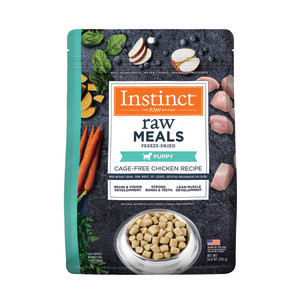
Instinct Freeze Dried Chicken Puppy
82/100
Instinct® is a brand that stands out in the dry dog food market. Their classic kibble offers more advantages than most other brands. Where the brand really shines is in its ‘freeze-dried’ line, which delivers the best of both worlds: the convenience of kibble combined with the less-processed nature of fresh food. This process is even superior to baked and air-dried kibbles like Carna4
✅ Pros
- Gentle cooking: 60 to 90% of nutrients are preserved with the freeze dried method.
- Less additives: Use of whole food ingredients and gentle cooking allows manufacturers massive use of synthetic additives.
- Adequate but moderate protein: 29% protein content may not be optimal for very active dogs or those requiring higher-protein diets.
- Quality proteins sourcse : cage-free chicken and turkey. Grass-fed lamb.
- Taurine is included
- High in proteins and fat (check with your vet if this fit with your puppy needs).
❌ Cons
- High in calories (you may need to split the meals).
- Very dry, 6% (rehydration required).
- The adult formula doesn’t provide enough information (calcium, ash, and phosphorus levels).
I and Love You


54/100
I AND LOVE YOU is a Colorado-based premium pet food brand known for its natural, grain-free formulas. With product lines like Naked Essentials, Nude Food, and Baked & Saucy, the brand prioritizes fresh ingredients and balanced nutrition. While they excel in many areas, there are a few concerns to consider.
✅ Pros:
The brand avoids synthetic additives, corn, soy, gluten, and high-glycemic ingredients, making it suitable for pets with sensitivities. Most formulas feature fresh meat as the first ingredient, with 70–75% of protein derived from animal sources. Protein levels are above average (30–34%), and added taurine supports heart health in grain-free recipes. Non-GMO certification and moderate carbohydrate content further enhance the appeal. Additionally, they offer raw food options as an alternative to kibble, and their customer support is responsive and transparent.
❌ Cons:
Some formulas have a high ash content (over 8%), indicating potential use of bone-heavy animal parts or excessive mineral supplementation. High calcium (1.61–1.86%) and phosphorus levels (1.18–1.30%) raise quality concerns and may not suit pets needing mineral control. Ingredient splitting with multiple plant protein sources listed separately also makes it harder to evaluate the true animal protein content.
Carbohydrates: A Problem?
Like humans, dogs can use carbohydrates as an energy source. However, carbs are not an essential part of their diet. Dogs are natural carnivores, meaning their ancestral diet is high in protein and fat but low in carbohydrates.
Many kibble brands, however, are loaded with carbohydrates, often from grains like corn, wheat, and rice or legumes such as potatoes and peas.
Why is this an issue?
Dogs cannot digest carbohydrates as efficiently as protein and fat. High-carb diets can cause rapid blood sugar spikes, potentially leading to long-term health issues like diabetes and obesity.
Additionally, dogs produce limited amounts of amylase, an enzyme needed to break down carbohydrates. Undigested carbs can ferment in the stomach, causing bloating, gas, and intestinal problems.
Kibble high in carbohydrates also tends to skimp on protein and fat, which are critical for muscle development, healthy skin and coat, immune function, and maintaining a healthy weight.
Aim for less than 30% carbs—this is already a good indicator of quality. For more details, check out our article on carbohydrate needs for dogs.
How to Calculate Carb Content
Most kibble brands don’t list carbohydrate percentages on their labels (surprise!). That’s because they don’t want you to see how high it really is.
Here’s how to calculate it yourself:
- Add up the percentages of protein, fat, fiber, moisture, and ash listed in the guaranteed analysis.
- Subtract that total from 100. The result is the carbohydrate percentage.
Example:
If a kibble contains 31% protein, 18% fat, 9% moisture, 8% ash, and 3% fiber:
31 + 18 + 9 + 8 + 3 = 69
100 – 69 = 31% carbs
Keep in mind, it’s impossible to have 0% carbs in kibble—some starch is necessary to bind the ingredients. A minimum of 20% starch necessary for binding the ingredients together.
What Kibble Should You Choose for Puppies?
Choosing the right kibble for your puppy is important to help them grow up healthy. Here are the key things to look for:
High-Quality Proteins
From the start, puppies need plenty of protein to support their rapid growth.
The best protein sources are fresh meats (like chicken, beef, or lamb), fish, and eggs. Animal-based proteins are superior because they contain all the essential amino acids. Be cautious with kibbles that rely too heavily on plant-based proteins.
👉 Look for a protein content of at least 28% or a protein-to-calorie ratio above 85 with at least 80% of the protein sourced from animals.
A Good Level of Fat
Fats are vital for providing energy to puppies. Omega-3 and omega-6 fatty acids, in particular, are essential for brain development, healthy skin, and a shiny coat. Good sources of fat include fish oil, flaxseed oil, and named animal fats.
👉 Aim for a fat content of 15% to 20% on a dry matter basis.
Proper Energy Density
Puppy kibble should have a higher energy density than adult kibble to support growth. This density may vary depending on the breed, the expected adult size, and the puppy’s activity level.
👉 Look for metabolizable energy levels between 3,600 and 4,000 kcal/kg.
Carbohydrates and Fiber
Carbohydrates also serve as an energy source for puppies. Look for quality carbohydrate sources like sweet potatoes, rice, brown rice, and vegetables such as zucchini and carrots. Fiber helps with digestion and promotes intestinal health.
👉 Choose kibbles with carbohydrate levels between 25% and 35%, depending on your puppy’s breed and needs.
Vitamins and Minerals
Puppies require a wide range of vitamins and minerals for healthy growth and development. Puppy kibble should include vitamins A, C, D, E, and K, as well as minerals like calcium, phosphorus, potassium, and magnesium.
👉 The calcium-to-phosphorus ratio should be between 1:1 and 1.5:1.
👉 Calcium levels should range from 1.0% to 1.3% (for large breeds) and can go up to 1.5% for others. Phosphorus levels from 0.7% to 1.2% on a dry matter basis.
Natural Additives
Natural additives are important too. Probiotics and prebiotics help establish good gut health. It’s also a plus if the kibble includes joint supplements like chondroitin sulfate and glucosamine.
These are almost the same criteria as for choosing kibble for adult dogs, except that for adults, you should opt for a slightly lower calorie density and a fat content ranging from 14% to 18%.
Note: if your puppy has digestive problems, you may want to look for a simpler, single-protein recipe that’s not too high in protein, as is the case with hypoallergenic kibbles.
What Kibble Should You Choose for Senior dogs ?
As scientific studies suggest, including “Nutrition of Aging Dogs“ by Linda P. Case, senior dogs undergo physiological changes that can affect their digestion and metabolism.
Feeding senior dogs is indeed a bit different. Some may start gaining weight, while others may lose it. With their metabolism changing, it’s important to adjust their diet accordingly. It’s also common to notice that an older dog can no longer tolerate foods they once digested with ease.
A Personal Anecdote
My childhood dog, who lived to 18 years old and ate a natural diet, loved oven-roasted chicken. However, as he aged, even a small piece of chicken cooked in vegetable oil would make him vomit.
Why? Because the fats from the roasted chicken had become indigestible for him. Older dogs have adjusted dietary needs for protein, fat, carbohydrates, vitamins, and minerals. This is why it’s often recommended to feed them a more natural diet rather than relying solely on kibble.
Protein Needs for Senior Dogs
It may be a good idea to lower the protein content a little, but it’s important to remember that older dogs don’t necessarily need less protein. They just need higher quality protein. You can aim for between 27% and 33% in dry food.
Fats and Essential Fatty Acids
For senior dogs, aim for a fat content of 12% to 14% on a dry matter basis, depending on their body condition and health. Essential fatty acids, such as omega-3s, are vital for healthy skin, a shiny coat, immune function, and cardiovascular health. However, for overweight dogs or those with heart disease, fat levels should be on the lower end of this range.
Carbohydrates and Fiber
Carbohydrates can make up 30% to 40% of a senior dog’s diet, depending on their energy needs and breed. Prioritize high-quality carbohydrate sources like sweet potatoes, rice, or vegetables, as these are easier to digest. Fiber levels should be 2% to 5% on a dry matter basis to support healthy digestion and prevent constipation, which is more common in older dogs.
Vitamins and Minerals
Senior dogs need slightly adjusted levels of certain vitamins and minerals:
- Calcium-to-phosphorus ratio: Ideally 1.1:1 to 1.4:1.
- Calcium: Between 0.8% and 1.2%.
- Phosphorus: Between 0.6% and 1.0%.
Ensure the diet also includes vitamins A, C, D, E, and K, along with potassium, magnesium, and zinc for overall health and vitality.